
Our policy research is informed by our commitment to policies that promote equity, sustainability, and efficient democratic government. We focus on concrete, implementable recommendations for mayors and city leaders.
By Topic
-
 The State of Water Affordability. Mayors Innovation Project & The Water Center.
This brief is part of a series of publications MIP has released that was originally researched and compiled as a technical assistance memo to a participating member city. This memo was written in 2021 in response to a specific research question submitted by that member city.
Document -
 Access to Paid Leave. Mayors Innovation Project.
COVID-19 has created a window of opportunity for advancing paid leave.
Amidst an ongoing economic recovery and global health crisis, providing paid leave is a benefit for both businesses and families. Across the board, paid leave policies have found positive benefits. However, without federal support, the burden falls to local governments.
How can cities make it happen?
Document -
 Resources on Improving Equity and Reducing Disparities in Policing. Mayors Innovation Project.
This brief is part of a series of publications MIP has released that was originally researched and compiled as a technical assistance memo to a participating member city. This memo was written in 2021 in response to a specific research question submitted by that member city.
For context, the original research question that prompted this memo was: Disparity in traffic stop rates are usually benchmarked to the driving population; is there a way to benchmark arrests and use of force in a similar way? When other cities evaluate their arrests, do they compare them directly to the overall population, or is there a more direct way to understand whether and how much Black people are being over-arrested? In addition, how do police departments know they are making progress towards equity? Are other cities or departments tracking police metrics over time? Are there proven methods for reducing racial disparity in policing? Have cities found success, even broadly defined?
Document -
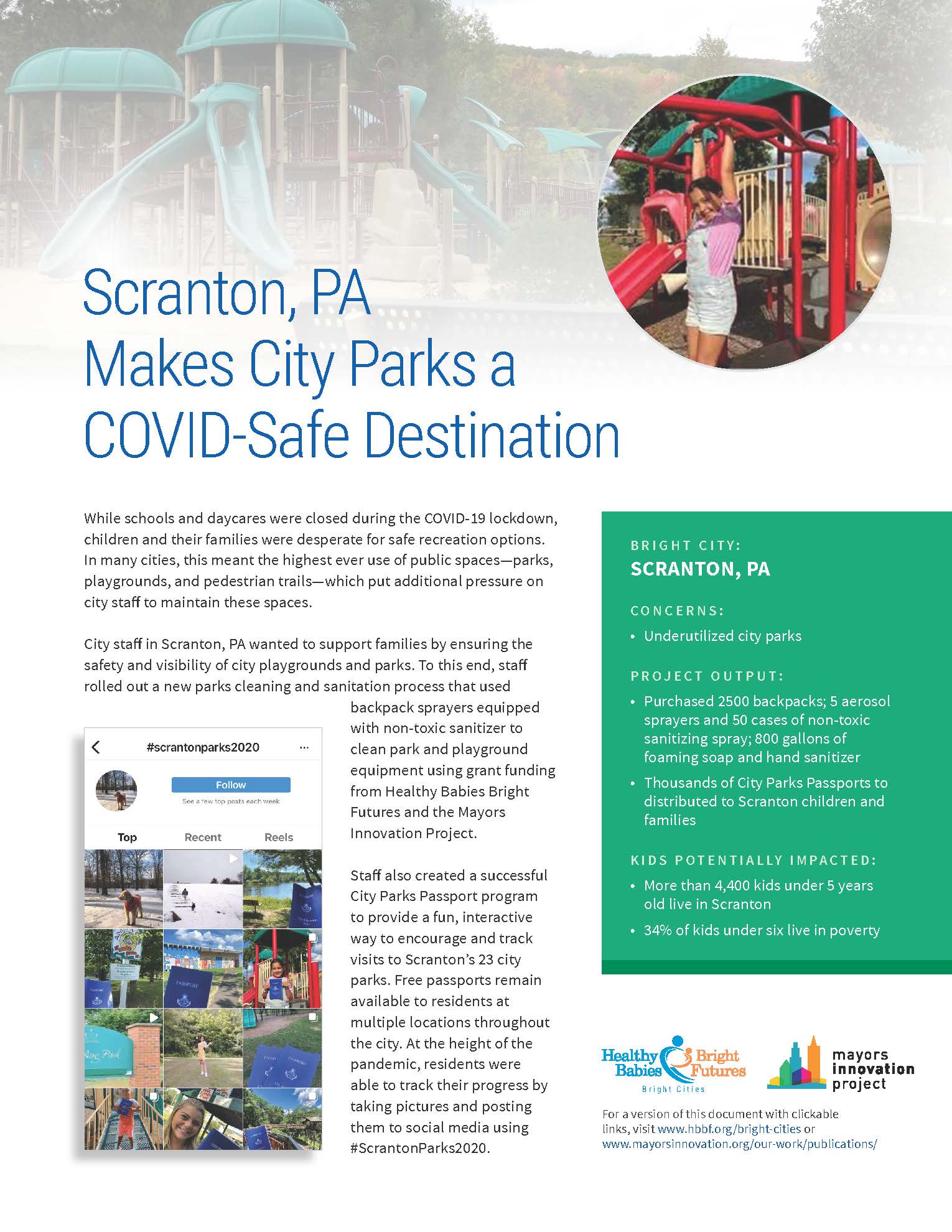
While schools and daycares were closed during the COVID-19 lockdown, children and their families were desperate for safe recreation options. In many cities, this meant the highest ever use of public spaces—parks, playgrounds, and pedestrian trails—which put additional pressure on city staff to maintain these spaces. City staff in Scranton, PA wanted to support families by ensuring the safety and visibility of city playgrounds and parks. To this end, staff rolled out a new parks cleaning and sanitation process that used backpack sprayers equipped with non-toxic sanitizer to clean park and playground equipment using grant funding from Healthy Babies Bright Futures and the Mayors Innovation Project.
Document -
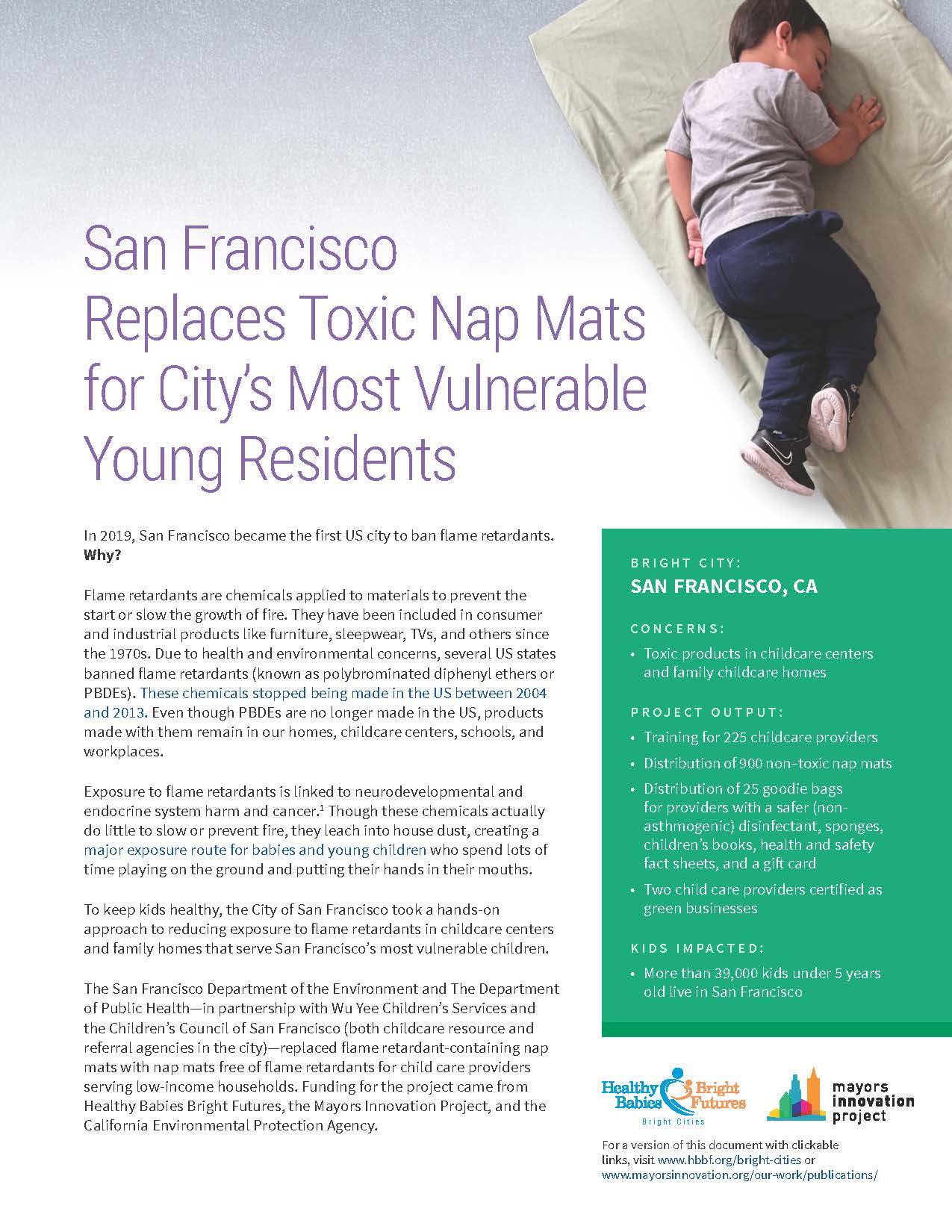
In 2019, San Francisco became the first US city to ban flame retardants. Why?
Flame retardants are chemicals applied to materials to prevent the start or slow the growth of fire. They have been included in consumer and industrial products like furniture, sleepwear, TVs, and others since the 1970s. Due to health and environmental concerns, several US states banned flame retardants (known as polybrominated diphenyl ethers or PBDEs). These chemicals stopped being made in the US between 2004 and 2013. Even though PBDEs are no longer made in the US, products made with them remain in our homes, childcare centers, schools, and workplaces.
Exposure to flame retardants is linked to neurodevelopmental and endocrine system harm and cancer.1 Though these chemicals actually do little to slow or prevent fire, they leach into house dust, creating a major exposure route for babies and young children who spend lots of time playing on the ground and putting their hands in their mouths. To keep kids healthy, the City of San Francisco took a hands-on approach to reducing exposure to flame retardants in childcare centers and family homes that serve San Francisco’s most vulnerable children.
Document